
SMART CITY · SITUATION CENTRE
One picture of the city. One incident, not fifty alarms.
Faceplate brings the city’s utilities onto one operating picture and gives the people on shift agents that connect the dots: what happened, who is affected, what to do first, and which option the digital twin has already checked.
10 kV feeder trip; pumping stations 3 and 4 down. 41 calls grouped.
Return temperature falling on one branch. Crew on site, leak suspected.
Feeder F-7 at 92% of limit by 19:00 at −14 °C.
Situational awareness
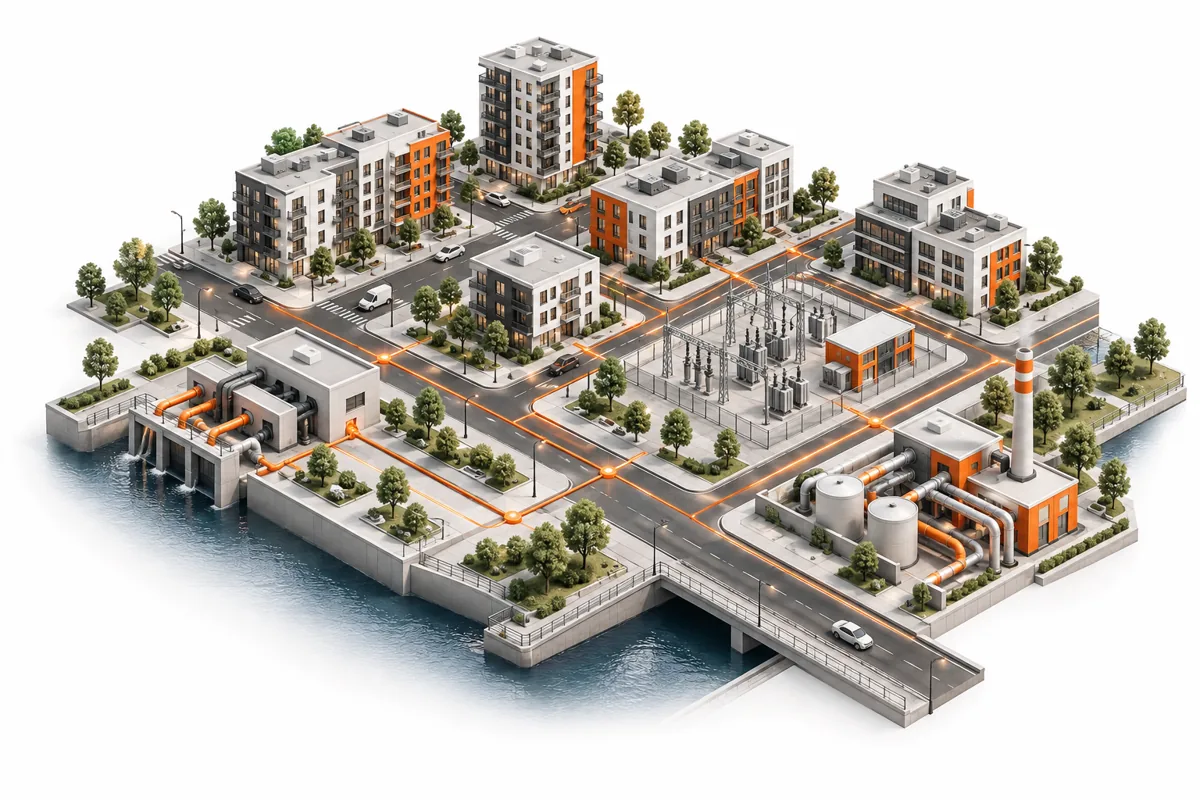
Every service on one map, each in its own control room.
Faceplate reads the SCADA and metering each utility already runs. Nothing is replaced on day one; the situation centre sees what every control room sees, in one place and in one time base.
- Power10 kV feeders, substations, outages and load by district.
- WaterPumping stations, pressure zones, reservoirs and losses.
- District heatingCHP output, supply and return temperatures, network setpoints.
- GasDistribution pressure, regulator stations and leak alarms.
- Street lightingCircuits, schedules and faults, shared feeders flagged.
- Weather and citizen callsForecasts, cold snaps and the calls that reach the dispatch line, grouped by place.
Dispatcher intelligence
Agents that work the shift with the dispatcher.
Each agent does one job well and shows its sources. The dispatcher sees a short list of incidents with their impact and checked options, instead of a wall of alarms from six systems.
- CorrelateOne incident, not fifty alarms
A feeder trip, two pumping stations and forty calls from one district become one incident, with the services it touches.
- ImpactWho is affected, and for how long
Residents, hospitals, schools and social facilities without power, water or heat, and the time to restore each.
- What-ifOptions checked before anyone acts
Switching, pump rerouting and heating setpoints run in the digital twin first. Unsafe options are marked before they reach the dispatcher.
- CrewsThe right crew, the nearest one
Which brigade is closest, with the equipment the job needs, and what it should check on arrival.
- ForecastThe evening peak and the cold snap, ahead of time
Heat and power demand against the weather forecast, with districts where the network will run short.
- Residents without water
- 12 400
- Hospitals on backup power
- 1
- Citizen calls grouped
- 41
- Below 2 bar, if no action
- 18:15
Options checked in the digital twin
Sources: grid SCADA · water SCADA · dispatch calls · twin run 18:09
18:05 · City utilities · winter evening peak
One incident, two control rooms
A feeder trips and the water pressure falls. Two control rooms, one cause.
18:07
A feeder trips.
A 10 kV feeder serving district 4 trips on overload. In the water control room, pressure in the same district starts to fall. Two rooms, two alarms.
18:08
The incident agent joins them.
Pumping stations 3 and 4 are fed from the tripped feeder. The pressure drop is not a burst main; it is lost pumps.
18:09
The twin compares two evenings.
Wait for the field crew and pressure falls below service level by 18:15. Restore the stations through the backup feeder and pressure recovers in ten minutes.
18:11
Both rooms agree.
The power dispatcher approves the switching. The water dispatcher is told not to start reserve pumps on the other side of the network.
18:14
Power returns to the pumps.
The backup feeder takes the load. Both pumping stations restart in sequence.
18:19
Pressure is back.
Most residents never noticed. The field crew finds the faulty feeder in daylight the next morning.
Morning brief
The city overnight, on one page, before the first meeting.
At 06:30 the brief agent writes what happened overnight, what is still open, where crews are, and which districts to watch today. It is written from the shift’s own data, with a link behind every line, ready for the head of the situation centre and the akimat.
- Incidents closed and still open
- Response and restoration times against targets
- Weather and demand outlook for the day
- Districts and assets to watch
3 incidents, 2 closed. District 4 power and water restored at 18:19 through backup feeder F-12.
District 2 heat main: leak confirmed at 02:40, crew on site, repair expected by 11:00.
Median 23 min from first alarm to crew assigned; target 30 min.
−14 °C tonight; heat demand +9% on yesterday. Feeder F-7 near its limit at the evening peak.
Every line links to its source: alarms, crew log, twin runs, weather service.
People stay in control
Advisor first. Every switching action has an owner.
- 01Read-only to start
The situation centre mirrors each utility’s data. No command reaches a network until the utility decides it should.
- 02The network’s dispatcher approves
An action on the power network is approved by the power dispatcher, on water by the water dispatcher. The situation centre coordinates; it does not override.
- 03Every decision is logged
Who approved what, when, on which evidence. The log is the basis for the post-incident report.
Why it holds
Built on the platform that dispatches a national grid.
This page describes platform capabilities. Screens show example data; district names and figures are illustrative.
Questions
What city teams ask first.
Do the utilities have to replace their SCADA?
No. Faceplate connects to the systems each utility already runs, over standard industrial protocols, and starts as a read-only mirror. Replacement is an option, not a requirement.
Can it combine data from different utilities and owners?
Yes. Power, water, heating, gas and lighting arrive in one model with one time base, while each utility keeps ownership of its data and its control.
Who can act on a network from the situation centre?
Only the dispatcher responsible for that network, and only after the action has been checked in the digital twin. The situation centre sees and coordinates; it does not override the utility.
Where does the data live?
On the city’s own servers. Faceplate runs on-premise, including the language models the agents use.
Plan a situation centre around the services you run.
An engineer walks you through the integration with your utilities, the first agents and the path from advisor to co-pilot.